Plate 01 · Research geography
Guanzhong is an association, not a surveyed boundary.
Sources repeatedly connect the Shaanxi Xigou with the Guanzhong and Wei River plain. The diagram locates places named in the record; it does not claim to map the present population.
WE
Relative placement is schematic. Markers mean “named in the documentary record,” not verified abundance or continuous range.
Geographic synthesis based on the CKU Shaanxi standard and the regional records cited in the landscape and culture chapter. A defensible population map would require dated, georeferenced field observations.
Plate 02 · Terminology matrix
One family, several kinds of name.
The words encountered in Chinese and English do not all operate at the same level. Some name an umbrella, some a region, and one names the dog in an institutional standard.
Plate 03 · CKU standard anatomy
The written standard, placed on the dog.
This plate translates selected features from the November 2017 CKU standard into an annotated reading aid. It describes the standard; it does not score the individual in the photograph.
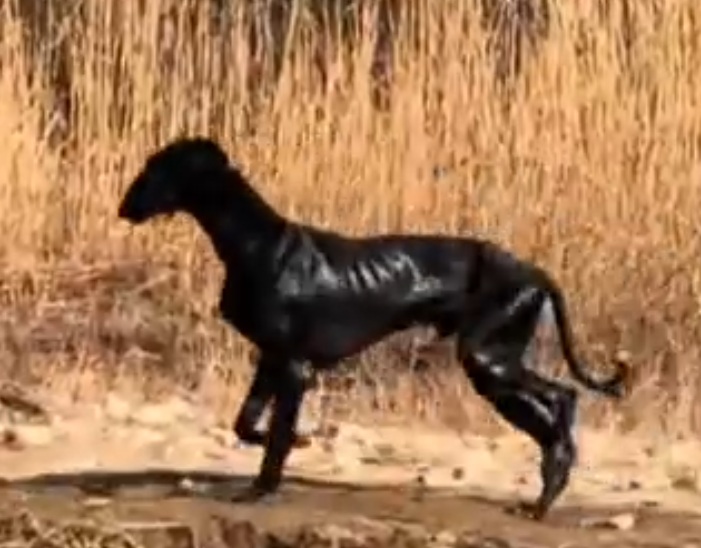 0102030405
- 01 · HeadLong and narrow; an unpronounced stop is preferred, while a convex foreface is accepted.
- 02 · EarLong, mobile and furnished with silky hair.
- 03 · OutlineA tall sighthound frame. Standard height: males 68–78 cm; females 65–75 cm.
- 04 · CoatSmooth, soft and silky, with feathering on limbs and thighs.
- 05 · TailLow-set, curved or ringed, and feathered.
The CKU standard lists multiple colours and gives no official weight range. Photograph: contemporary documentary image, CC0.
Primary source: CKU — Xian Hound / 陕西细犬 standard. The complete evidence-led reading is on the regional types page.
Plate 04 · Genomic study comparison
Compare questions before comparing numbers.
Three papers include Shaanxi-associated sighthounds. Only the two FROH bars below share a method and study; the other metrics answer different questions and must remain separate.
Genome-wide diversity
- Inbreeding coefficient
- 0.28
- LD extent
- 77.79 kb
SNP-based estimates. The published geographic spelling is inconsistent with Shaanxi usage.
Runs of homozygosity
Within this study, the sampled Shaanxi group had the highest FROH among fourteen populations.
Sighthound ancestry
This supports a complex contact history, not an exact donor breed, date or one-direction origin story.
Primary studies: Yang et al. (2019); Li et al. (2023), Frontiers in Veterinary Science; Li et al. (2023), Molecular Biology and Evolution.
Plate 05 · Bilingual field glossary
Five names worth preserving in both scripts.
Literal translations are orientation aids, not complete definitions. Pinyin tone marks are included because romanisation alone can hide meaningful differences.
xì gǒu
slender / fine dog
Broad vernacular umbrella; the name most often rendered as Xigou in English.
xì quǎn
slender / fine hound
A more formal wording found in standards, institutional names and written sources.
Shǎnxī xìquǎn
Shaanxi slender hound
The Chinese name used for the Shaanxi dog in the CKU standard.
Qín xiǎn
Qin xian
A historical or literary regional name; not a direct synonym in every period or source.
Guānzhōng xìgǒu
Guanzhong Xigou
A geographic vernacular name associating the dog with the Guanzhong region.
Editorial convention: this guide uses Xigou for the broad topic and Shaanxi Xigou where the regional population is meant. See method for the evidence and naming policy.