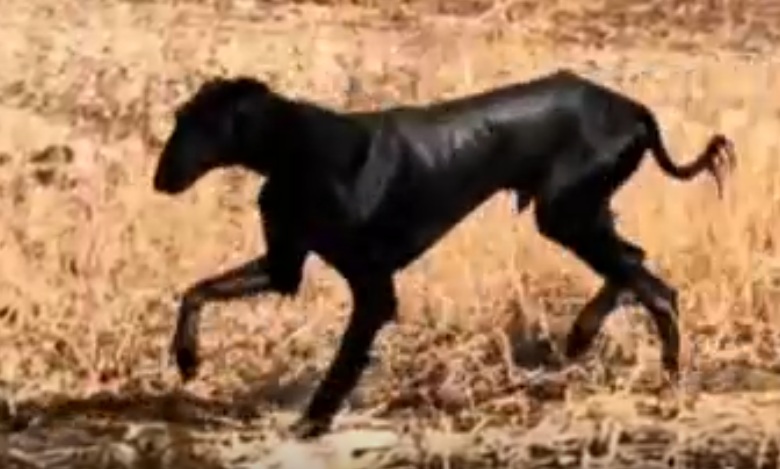
Place
The Weihe plain is part of the description.
Shaanxi Xigou sources repeatedly centre the Guanzhong or Weihe plain—especially the belt around Weinan, Xi’an and Xianyang. Long sight lines and cultivated open ground help explain why speed, visual pursuit and agility became useful traits.
Place does not create an immutable type, and today’s dogs should not be reduced to an environmental fable. But removing geography from the account leaves only measurements. Regional vocabulary, owner knowledge and working use belong beside the formal standard.
Language in use
细狗撵兔: Xigou chasing hare.
The phrase xigou nian tu (细狗撵兔) names a seasonal hare- coursing practice documented around Pucheng and elsewhere in the Guanzhong region. It records the dog as part of rural work and recreation, not simply as a show-ring outline.
Contemporary reporting describes riders or handlers crossing open fields with hounds that pursue by sight. This guide documents the cultural record without encouraging the practice, which is subject to wildlife law, animal-welfare considerations and changing local conditions.
Cultural source: China Daily Chinese-language feature on Pucheng’s 细狗撵兔 tradition.
Modern documentation
From local knowledge to an institutional standard.
Conservation work begins
CKU’s native-breed programme records the start of organised Shaanxi Xigou work.
Appraisal and registration
An appraisal, seminar and registration activity is held in Xi’an.
Dedicated event
CKU reports a dedicated Shaanxi Xigou event in Xianyang.
Valid standard
The CKU Xian Hound / 陕西细犬 standard carries a November 2017 effective date.
This chronology documents formalisation, not the beginning of the dogs themselves. Institutional selection records one version of a regional tradition; field evidence is still needed to show how much variation persists beyond that framework.
Institutional sources: CKU native-breed programme review; CKU 2017 activity record; 2017 standard.
Limits
The next gaps in the public record.
Heritage status
Secondary and institutional articles describe local intangible-cultural-heritage recognition, but the corresponding primary listing has not yet been located. The status is therefore reported, not treated here as verified.
Current population
No public official breed-level table supports a defensible current national count. Survey headlines should not be converted into a precise census.
Regional vocabulary
Terms such as Qin Xian, Guanzhong Xigou and Shaanxi Xiquan overlap. Dated, place-specific oral histories would clarify where each name is actually used.
Contemporary field record
Rights-cleared photographs with date, place and identification remain scarce. The two modern photographs used by this site are CC0 and explicitly identify Shaanxi Xigou, but lack fuller field metadata.